Binding supplier contracts – no paper, no signature, a complete record
 Robert Reiz | 15. Oktober 2026 | 09:21 UTC
Laura is CFO of Nordlicht Digital GmbH. In March her team needs extra hands for a client relaunch at short notice. The project manager calls Jonas, a freelancer, they agree on the phone, and a short email follows: "As discussed, €95 per hour, starting 1 April." Jonas replies: "Sounds good, I'm in." That's a contract – perfectly valid in law.
Eight months later an invoice at €105 per hour lands on Laura's desk. Jonas remembers a second phone call in which the higher rate was agreed for on-site days. The invoice also lists 22 hours that nobody ever approved. The project manager who made those calls has since left the company. The email still exists – but it says nothing about on-site days, nothing about payment terms and nothing about which hours may actually be billed.
In the end, whoever can prove it wins.
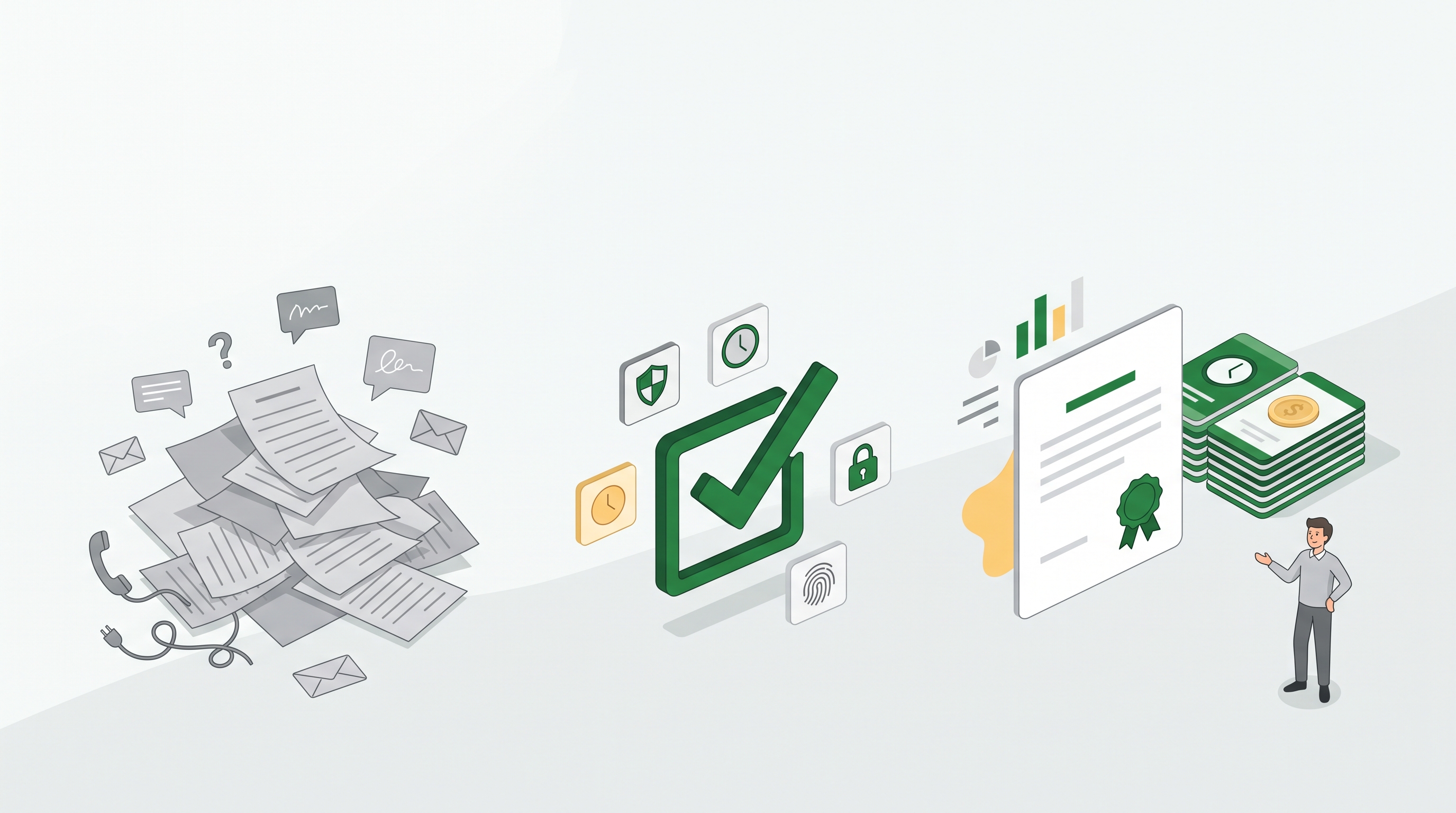
With ZEIT.IO you conclude supplier contracts on a legally binding basis – without paper and without a handwritten signature. Every acceptance is fully documented, and both sides receive the complete contract as a PDF.
B2B contracts don't need a signature
A common misconception: a contract only counts once it's signed on paper. Under German law, the opposite is the rule. A contract comes about through offer and acceptance (sections 145 ff. of the German Civil Code, BGB) – and as a rule, no particular form is required. An offer by email and an acceptance by email make a valid contract. So does a handshake on the phone.
That also covers the typical work with freelancers and service providers: service and work contracts between businesses don't require any form. You need no handwritten signature for them – and no qualified electronic signature either.
So the problem isn't whether a contract exists. The problem is what exactly was agreed – and whether you can prove it in a dispute. Whoever relies on an agreement may have to prove it. And that's exactly where email and phone fall short:
- Phone calls leave no trace.
- Email threads are scattered, incomplete, forwarded, sometimes deleted.
- A "sounds good" in an email doesn't say which version of the offer it refers to.
- Who actually hit "reply" is hard to establish.
What changes now
Accepting is a deliberate, unambiguous statement
A supplier contract in ZEIT.IO contains everything the collaboration is about: term, notice period, project, compensation – an hourly or a daily rate, optionally with up to four categories and your own labels such as "Remote" or "On site" –, payment term, early-payment discount (Skonto) and the credit memo procedure.
The supplier accepts this offer directly in ZEIT.IO. To do so, they have to actively tick the box "I accept this as legally binding". Only then does the button "I accept this offer on a binding basis" become active. Nobody can claim later that they were "just having a look".
If the supplier has turned on two-factor authentication, ZEIT.IO also asks for the "2FA Code" when they accept. That shows it really was the account holder who accepted – not someone who happened to sit at an unlocked laptop.
Every acceptance is fully recorded
When the supplier accepts, ZEIT.IO stores on the contract:
- the date and time of acceptance,
- who accepted – with name and email address,
- the IP address and the browser used.
On top of that comes the contract's change log: who changed which field when, from which value to which? You can open it at any time on the contract's Auditlogs tab.
The contract as a PDF – for both sides
As soon as the supplier accepts, ZEIT.IO generates the contract as a PDF:
- It starts with the Client and the Contractor – each with their full name and address.
- It contains every agreed term: subject, term, notice period, project, compensation, payment term, Skonto, credit memo procedure and bank details.
- It shows the unique contract ID in ZEIT.IO as well as when and by whom it was accepted.
- The footer is the same as on your invoices.
Internal figures stay internal: your sales rate to the end client and your margin are not in the PDF.
The supplier receives the PDF by email – their own copy, even if they stop using ZEIT.IO one day. The person who created the contract gets it too, attached to the notification that the contract was accepted, as long as they can still read supplier contracts. And on the contract page, both sides can download it at any time under "Contract as PDF".
For supplier contracts accepted in the last 12 months, we generate the PDF retrospectively – without sending any emails.
Accepted means: unchangeable
An accepted contract can no longer be edited or deleted. Otherwise the stored contract would no longer prove what was actually accepted.
If something changes – the hourly rate, say – that goes through a change request, which the supplier again has to accept explicitly. The PDF is then generated with the new terms and sent again; it shows when the change was accepted.
A clear rule for billing
The contract and the PDF say it explicitly: times and expenses must be booked on ZEIT.IO. Only times and expenses approved on ZEIT.IO are paid. Times and expenses that are not approved will not be paid.
That settles exactly the point where things went wrong in Laura's case.
What stays the same
- Your suppliers need no signature, no printer and no scanner.
- As the client, your process stays the same: create the contract, send it to the supplier, done.
- Employee contracts are not affected by these changes.
One honest limitation: for a few kinds of contract, the law requires a particular form – written form for temporary agency work (Arbeitnehmerüberlassung), for example. For those, accepting in ZEIT.IO does not replace the required form. That doesn't apply to the usual engagement of freelancers and service providers. This post isn't legal advice; for your specific case, please ask your legal counsel.
Why this matters
Email and phone are good enough in law – but a poor archive when there's a dispute. With ZEIT.IO, every supplier contract comes with an unambiguous acceptance, a timestamp, a change log and a PDF that both sides hold. When it counts, you hand it over instead of searching for it.
And the contract is only the beginning: on the same platform your supplier books their times and expenses, your team approves them, and if you like, ZEIT.IO creates the credit note automatically. From offer to payment – all in one place, all traceable.
Binding without paper. Provable down to the last hour.