False self-employment: Why you can no longer ignore this issue in 2026
 Robert Reiz | July 17, 2026 | 04:25 UTC
 Have you been working for the same client for months—attending their meetings, using their tools, and coordinating your vacation with the team? Then you should keep reading. Because that is exactly what "bogus self-employment" looks like—and the consequences affect not only your client but you as well.
The Problem: Freelancing in Germany is under general suspicion
"Bogus self-employment" (Scheinselbstständigkeit) means that you present yourself as self-employed but, in practice, work like an employee. What matters is not what your contract says, but how the working relationship actually plays out in reality. The German Pension Insurance (DRV) scrutinizes this closely during its audits—and it audits every company at least once every four years.
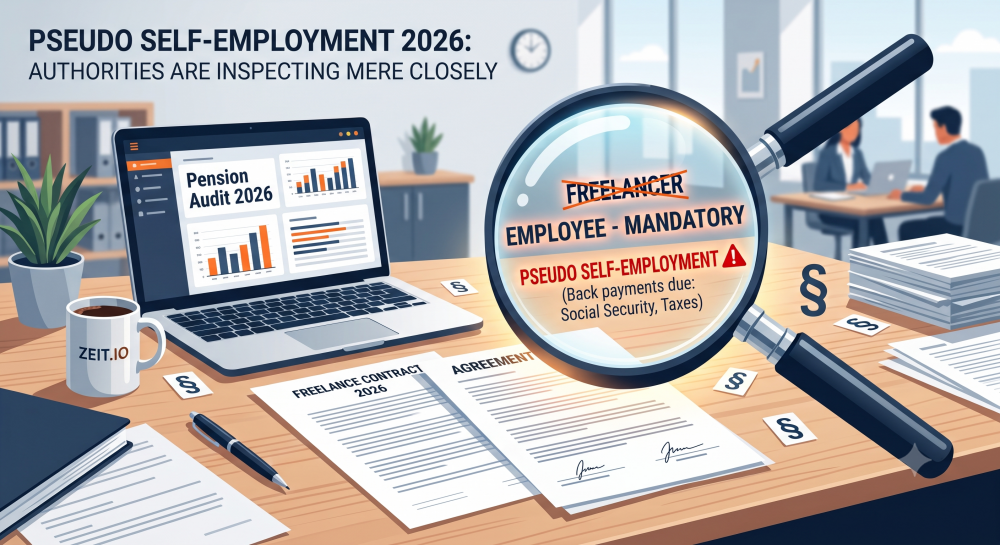
You may already be familiar with the basic criteria: being subject to instructions and integration into the client’s organizational structure (Section 611a BGB, Section 7 SGB IV). In practice, this means: fixed working hours, a desk at the client’s premises, an email address using the client’s domain, working for only one client over an extended period, and not using your own equipment. No single point is a deal-breaker on its own. However, the cumulative effect is what matters—and many freelancers tick these boxes without even realizing it.
What happens if this comes to light? It becomes extremely costly for the client: social security contributions are claimed retroactively for up to four years—or up to 30 years in cases of willful misconduct. On top of that, management faces personal criminal liability (Section 266a StGB—carrying a prison sentence of up to five years). For you as a freelancer, it means your contractual relationship is retroactively reclassified as an employment relationship, your invoices and VAT status are called into question, and—in the worst-case scenario—you lose the contract and the client.
And that is precisely where the real problem lies for you: more and more companies are responding by imposing blanket bans on freelancers. It is not that they don’t want to work with you, but rather that the risk has become too high for them. Compliance departments block contracts, procurement teams demand proof of status, and projects fall through. Ongoing debates regarding new regulations on self-employment are only fueling uncertainty on both sides. In short: your problem isn't just the German Pension Insurance (DRV). Your problem is that, without a solid compliance narrative, it is becoming increasingly difficult to land good contracts.
The Solution: keine-scheinselbststaendigkeit.de
That is exactly why we built keine-scheinselbststaendigkeit.de—a legally vetted compliance solution addressing the issue of "bogus self-employment" (Scheinselbstständigkeit), developed by scaliify in partnership with the law firm ZIRNGIBL Rechtsanwälte.
Here’s how it works:
1. Self-assessment. In just a few minutes, you can check the status of your current contracting arrangement for free. No sign-up required, no legalese—just concrete questions about your actual work situation, resulting in a clear picture of your risk profile.
2. Compliance check. If the self-assessment flags potential issues, we examine the details together: your contract, actual day-to-day practices, and communication with the client. We point out the red flags and show you exactly what changes you can make.
3. Protection. Contract structuring designed to withstand a DRV (German Pension Insurance) audit. Preparation for the official status determination procedure (§ 7a SGB IV) if you want proactive clarity. Plus, ongoing monitoring to ensure your setup remains compliant six months down the line.
Why this beats the alternatives
Just seeing a lawyer? You get a legal opinion—sound from a legal standpoint, but no one implements it for you. A legal document doesn't change how you and your client actually work together day-to-day. And it is precisely that day-to-day reality that matters during an audit.
Relying on a freelancer platform? Platforms broker assignments but often offload the compliance issue onto standard contracts. Standard contracts that fail to reflect actual working practices are worth virtually nothing during a DRV audit.
Just hoping nothing happens? This used to be the most popular strategy. It works less and less effectively—see above.
Our approach combines the two things you really need: legal protection provided by ZIRNGIBL and operational HR expertise from scaliify. We don’t operate in the realm of theory; we have seen—across more than 40 HR projects—how companies engage freelancers, where the friction points lie in day-to-day operations, and why compliance audits actually fail. The result isn’t a report destined to gather dust in a drawer, but a compliance model that works in practice—for both you and your client. You won’t find this combination anywhere else on the German market.
A nice side effect: When you can demonstrate to your client that your setup has been vetted and is fully compliant, you cease to be a risk and become an asset. Compliance shifts from being a deal-breaker to a selling point.
The person behind it

Ben Böhmer brings over 15 years of experience in the "People" space—spanning tech, e-commerce, and medical technology. He has built teams across Germany, the UK, France, Italy, and Spain, and—in a single project—hired and onboarded more than 350 people in just eight months. As an interim HR manager and HR digitalization consultant, he has witnessed countless freelance engagements from the corporate perspective—including those moments when the German pension insurance authorities (DRV) showed up at the door and suddenly everyone got nervous.

Sarah Mittiga brings over ten years of project management experience in sales and marketing—spanning real estate, banking, FMCG, and tourism—along with a Big 4 consulting background in innovation and change management. Her specialty: building business models that remain effective even as laws, markets, and technologies evolve. In short, exactly what the field of freelancer compliance needs right now.
What drives us: We have sat on both sides of the table. We have seen companies let go of talented freelancers out of fear—and seen freelancers lose their most important contracts overnight, despite being top-tier professionals. The absurdity of it all? Almost all these cases could have been avoided. Not through tricks, but through a solid setup right from the start. Misclassification (disguised employment) is not an inevitable fate—it is a solvable compliance issue. And that is precisely the problem we solve.
Your next step
If even one of the points above made you think, "Hmm, that applies to me," then take the free self-assessment. It takes five minutes, and you’ll know where you stand. And if you’d like to speak with us directly, book a free initial consultation—we’ll review your setup together, without the legalese or scare tactics.
Note: This article does not constitute legal advice for individual cases. Whether a specific working relationship qualifies as "bogus self-employment" always depends on an overall assessment of the circumstances. Our partners at ZIRNGIBL Rechtsanwälte are available to provide a legal evaluation of your case.