Tax hints for Electronic Invoices
 Robert Reiz | 27. Mai 2026 | 05:03 UTC
 ZEIT.IO is a SaaS solution for the automated billing of project time. Freelancers and employees can record their project hours on ZEIT.IO and submit them for approval. Once the submitted services have been approved by an authorized approver, the corresponding outgoing invoice is immediately generated and sent to the client.
As of October 2024, all invoice documents generated on ZEIT.IO are e-invoices compliant with the EN16931 standard. This article addresses tax-related considerations regarding e-invoices.
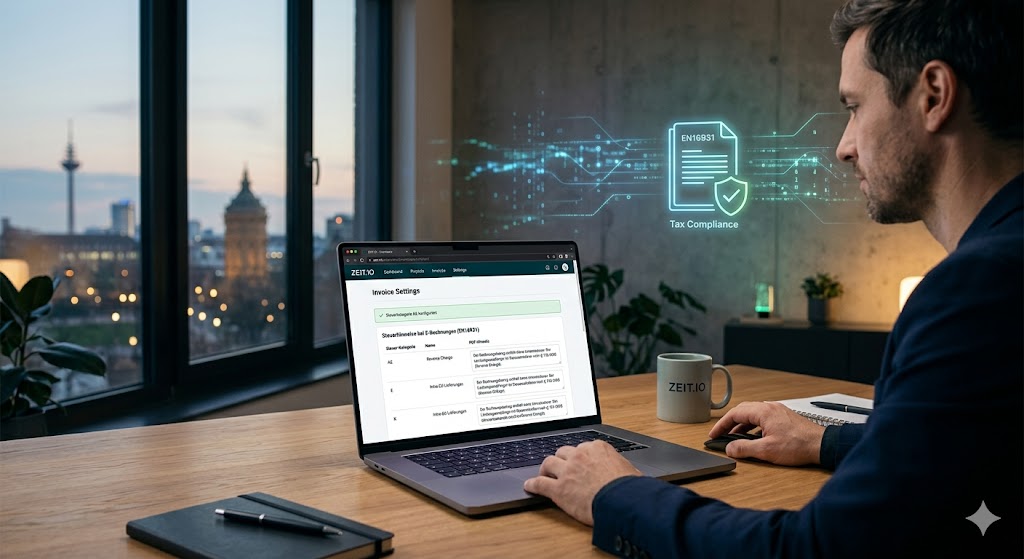
Most ZEIT.IO clients are agencies that broker freelance experts or consulting firms that bill on a "Time & Materials" basis. All these companies are billing for services—typically, project hours. It is not uncommon for these invoices to be issued to international clients. For B2B invoices issued to foreign entities—specifically those billing for services—the VAT rate is always 0%, and the invoice must include a so-called "Reverse Charge" notice. For example, as shown here:
Reverse Charge - According to Article 196 of Council Directive 2006/112/EC, VAT liability rests with the service recipient [%{recipient_taxid}].
Based on the addresses of both the issuer and the recipient, ZEIT.IO automatically determines whether a Reverse Charge scenario applies and, if so, automatically adds the corresponding notice to the invoice PDF.
Reverse Charge with E-Invoicing
With the introduction of e-invoicing in accordance with EN16931, the traditional "Reverse Charge" notice is no longer strictly necessary. EN16931 introduces specific tax categories to cover various tax scenarios. The tax category code AE designates the Reverse Charge mechanism.
The tax category code is a mandatory field on every e-invoice compliant with EN16931. This tax code must be specified for each individual line item (trade item) on the invoice.
There are various implementations of the EN16931 standard—such as the ZUGFeRD format, XRechnung, or Peppol BIS 3 Billing. The ZUGFeRD format is a hybrid format consisting of a PDF file with an embedded XML file. The PDF serves as the visual representation, but the actual e-invoice is the embedded XML file. According to the BMF (Federal Ministry of Finance), the XML file acts as the authoritative record. Whatever is stated in the XML file takes precedence! The visual representation in the PDF is secondary. If the tax category code AE is used within the XML file, this unequivocally signifies that the Reverse Charge mechanism applies—regardless of what is stated in the PDF file! Consequently, the traditional "Reverse Charge" notice displayed on the PDF is no longer the decisive factor.
Nevertheless, for such invoices, ZEIT.IO continues to add the "traditional" Reverse Charge notice to the PDF. We do this simply because many customers are accustomed to seeing it there.
Intra-Community Supply
"Intra-Community Supply" refers to the shipment of physical goods to other EU member states. For this purpose, the tax category code K is used. For example, if you sell computers from Germany to Italy, this transaction falls under tax category code K.
Export Supply (Export)
The tax category code G is designated for the export of goods to third countries (non-EU countries). This refers to the delivery of physical goods from an EU country to a non-EU country. For example, if you sell computers from Germany to the USA, this constitutes an export delivery (export) and falls under Tax Category Code G.
Overview of Tax Category Codes
The EU has defined various Tax Category Codes for different use cases. There are more Tax Category Codes than are covered in this article; here, we address the codes that are relevant to ZEIT.IO customers. Here is a brief overview:
| Tax Category Code | Meaning | Explanation |
|---|---|---|
| S | Standard | The standard tax code for the standard VAT rate applicable to domestic transactions. |
| AE | Reverse Charge | Used for B2B transactions involving the provision of services to foreign countries. |
| K | Intra-Community Supply | Used for the sale of goods to other EU countries. |
| G | Export Delivery (Export) | Used for the sale of goods to third countries (non-EU countries). |
As previously mentioned, there are additional codes; however, these are the most common ones and the most relevant for the ZEIT.IO community.
Informational Notes in ZEIT.IO
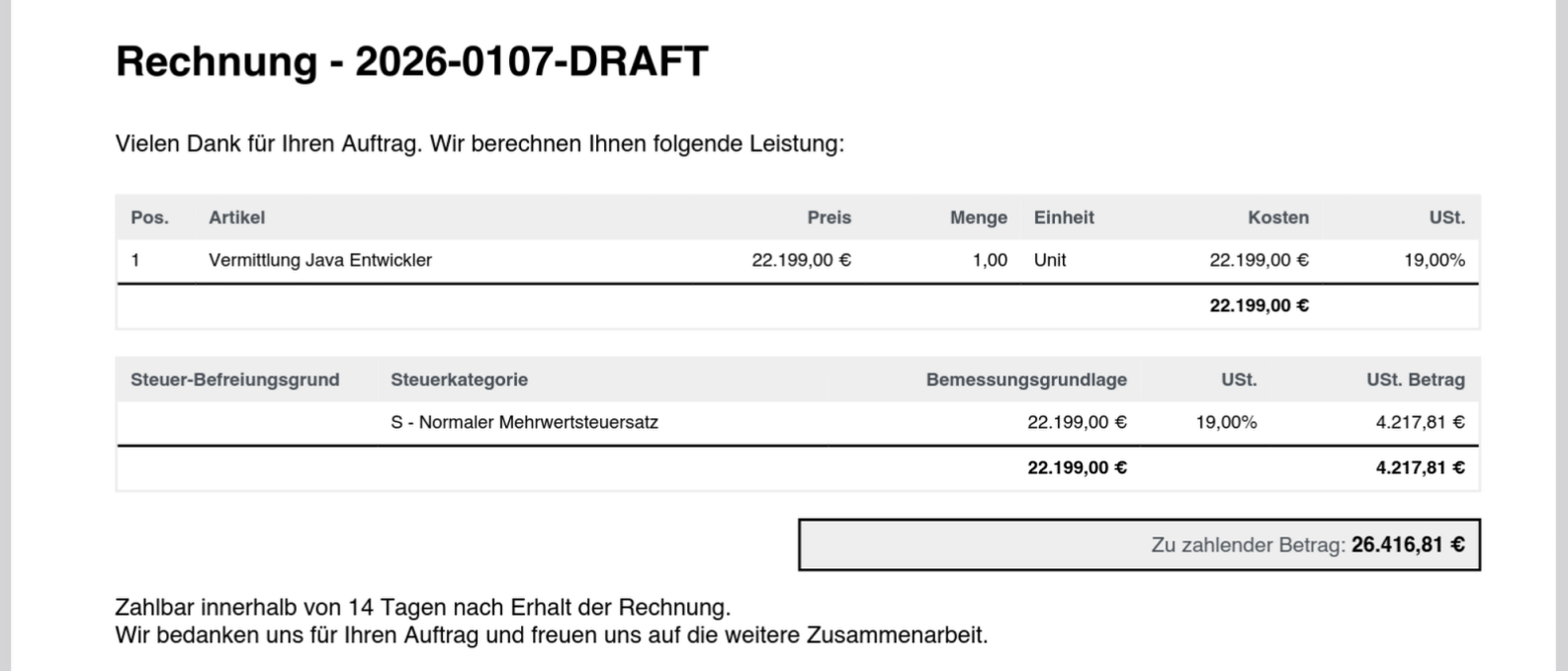
In the PDF view, ZEIT.IO also displays the tax category code derived from the e-invoice. Here is an example:
Depending on the specific tax category code, ZEIT.IO adds a corresponding tax-related informational note to the PDF. This note always appears within a yellow box. Here is an example:
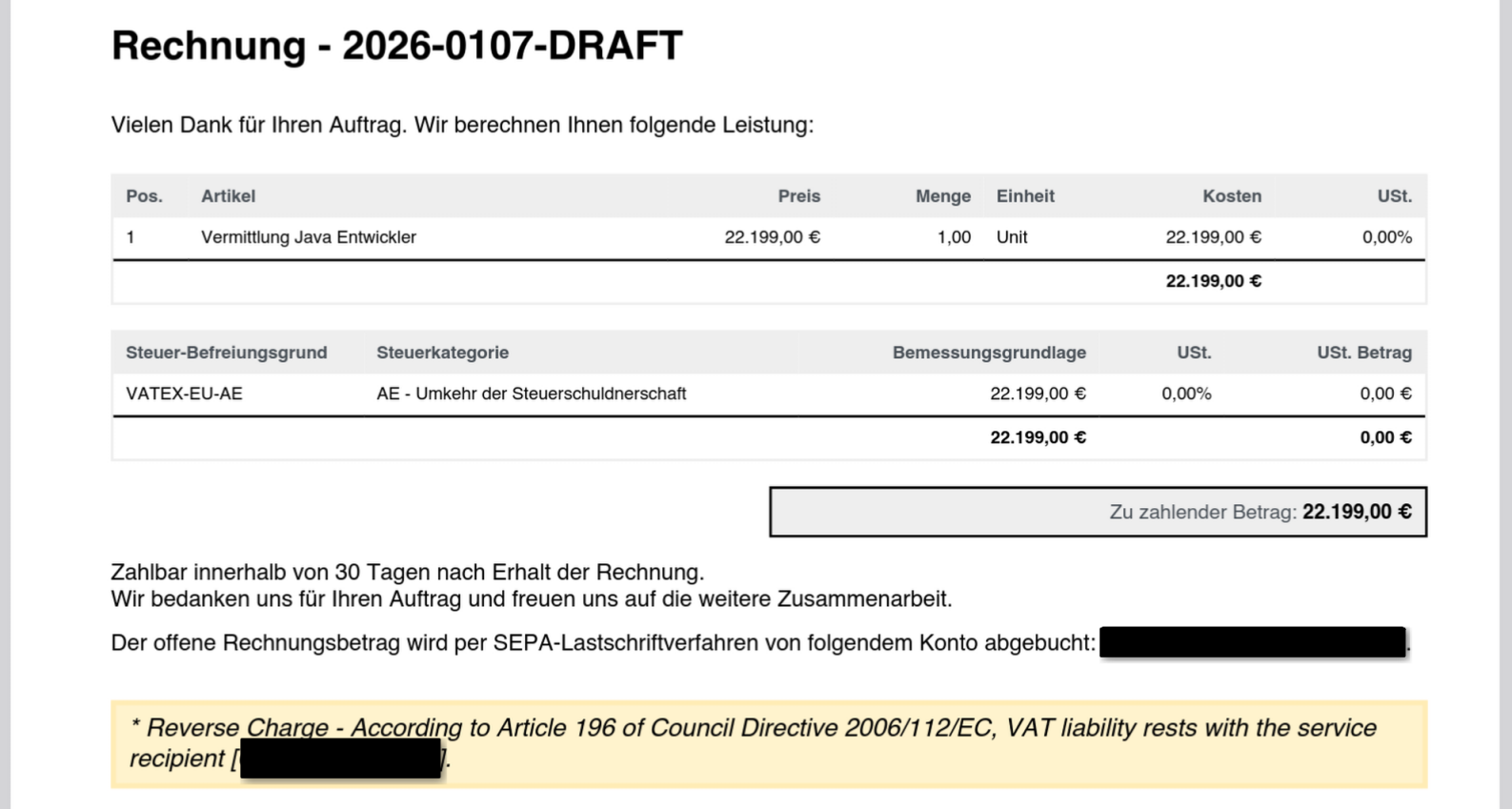
These "traditional" informational notes continue to be included for the following reasons:
- Many recipients do not yet have an e-invoice viewer.
- Many recipients are unfamiliar with e-invoicing and still look for these specific notes directly on the invoice document.
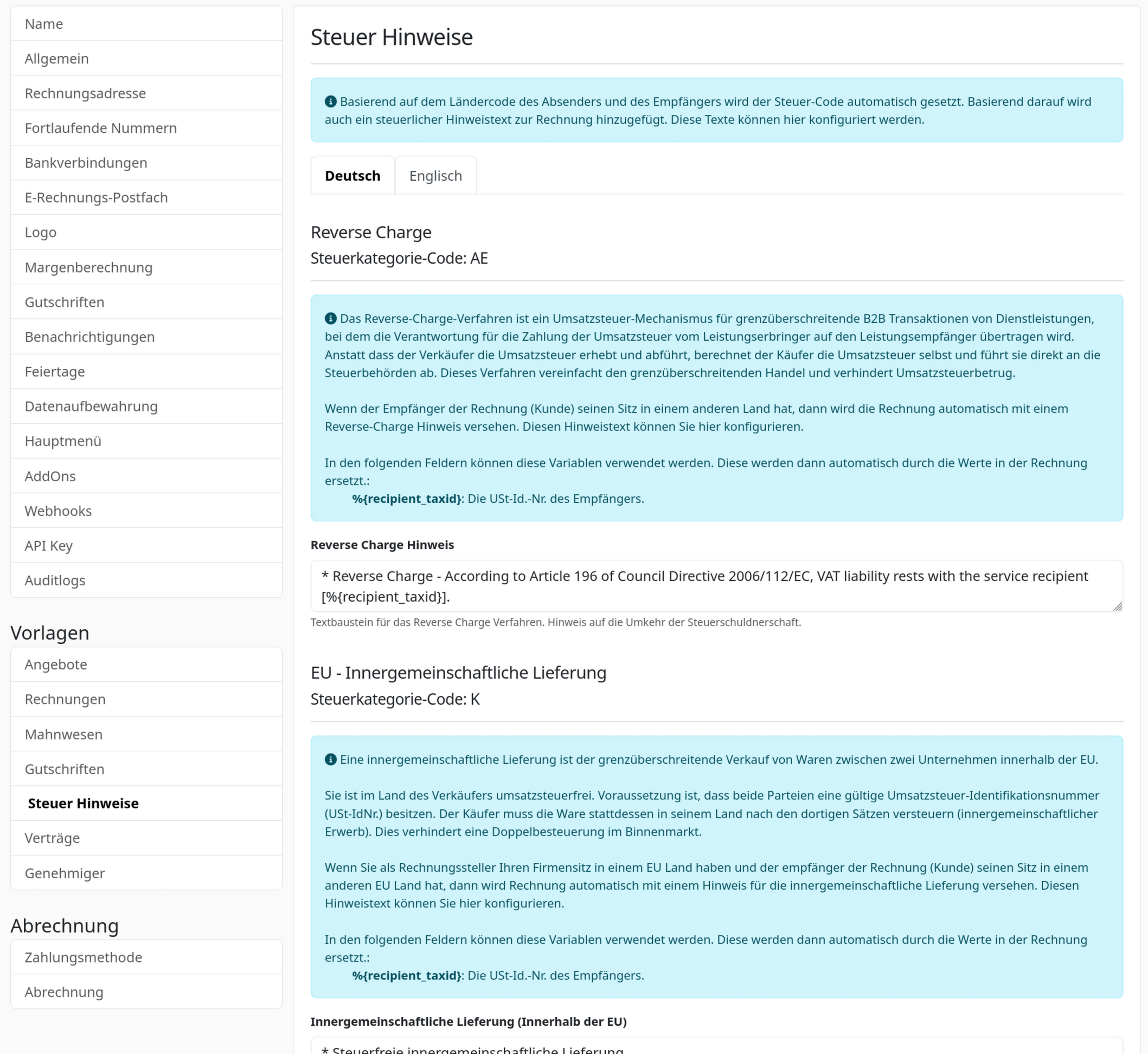
Incidentally, these informational notes—assigned per tax category code—are fully customizable within ZEIT.IO. In the Organization Settings (located in the menu on the left side), you will find a menu item labeled "Tax Notes" (Steuer Hinweise). You can use this section to customize all of these text entries.
Legal Disclaimer
I am neither a tax advisor nor a lawyer. All information provided herein is without guarantee. Please consult your tax advisor regarding any tax-related matters.
FAQs
Does the tax code "AE" apply only to reverse-charge transactions within the EU?
No! In the current ZUGFeRD 2.4.0 standard, there is no mention of any restriction to the EU specifically regarding the tax code AE. Accordingly, AE can be used for all instances of reverse charge, even if the recipient is located outside the EU.
Can an invoice contain multiple tax category codes?
Yes! Absolutely! For an e-invoice sent abroad that includes multiple line items, it is indeed possible to have two different tax category codes. Here is an example: In a B2B invoice sent from Germany to Austria, both consulting hours (a service) and a USB stick (a physical product) are being billed. In this scenario, the line item for the service would require tax category code AE, while the line item for the USB stick would require tax category code K. This would constitute a typical e-invoice featuring two tax codes.