Four project types, one clear logic
 Robert Reiz | 25. August 2026 | 14:25 UTC
 Why we reorganised the project types
When you create a project in ZEIT.IO, the project type is the decision that governs everything that follows: which budgets exist, how costs accrue, and how the margin is calculated at the end.
Historically these project types had grown over the years. Some differed only in nuance, others carried names that no longer matched what they actually did. For you as a controller or project manager, that meant it was not always obvious where a given figure in a report had come from.
So from now on there are exactly four project types — and for each one, a single documented answer to three questions.
The three questions every project type answers
Every project type in ZEIT.IO answers the same three questions. The difference between them lies entirely in the answers:
| Question | What sits behind it |
|---|---|
| How do you sell? | Do you bill by effort, or at a fixed price? |
| How do you buy? | Do you pay the people delivering the work by the hour, or a fixed price? |
| Where does the margin come from? | From the difference between exactly those two sides. |
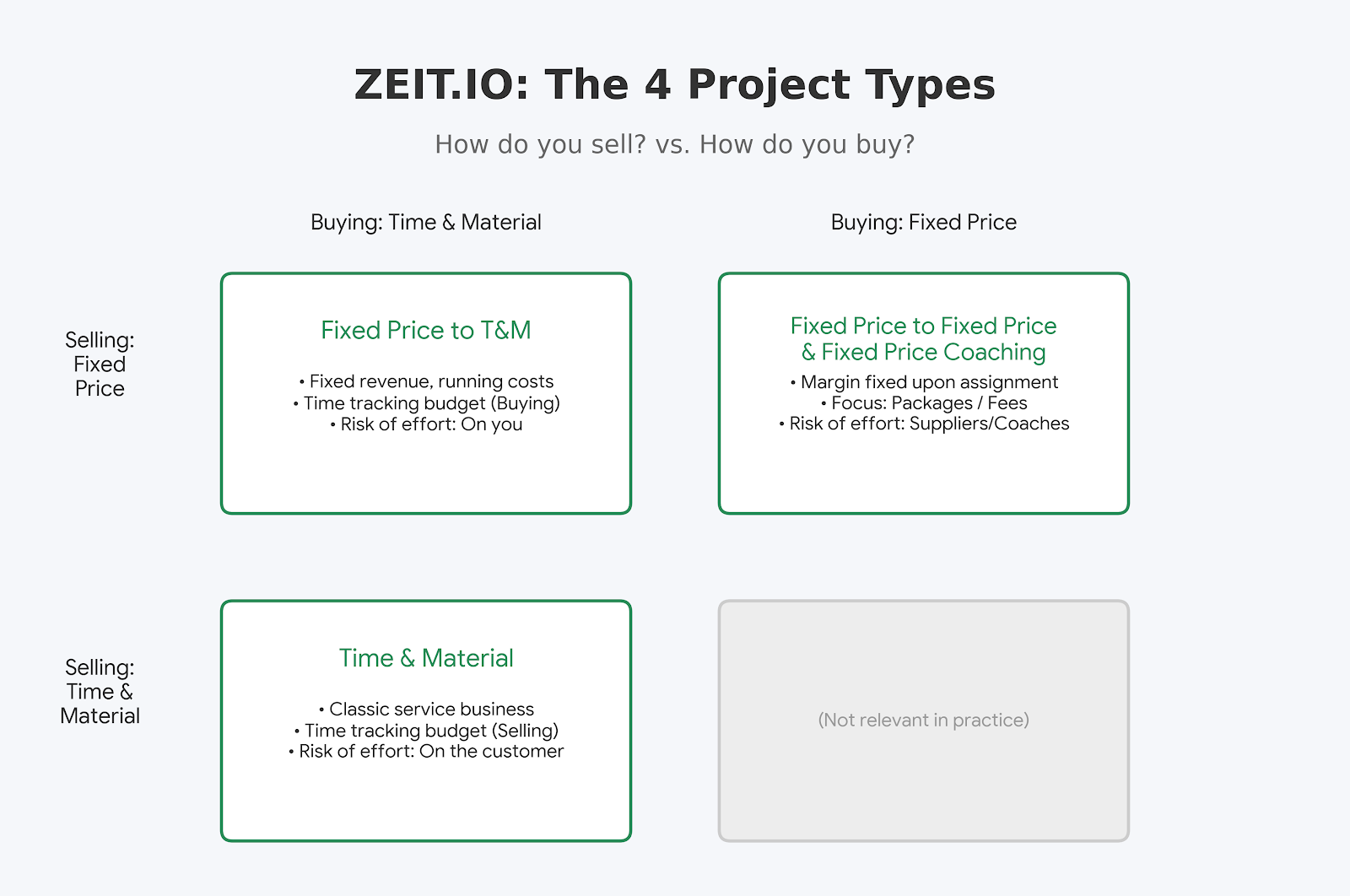
The two possible answers to the first two questions produce the matrix that the four project types are built on.
The four project types at a glance
| Project type | You sell | You buy | Typical use |
|---|---|---|---|
| Time & Material | by effort | by effort | Classic consulting, staff augmentation, ongoing support |
| Fixed price to fixed price | at a fixed price | at a fixed price | Work contracts you pass on to subcontractors |
| Fixed price to time & material | at a fixed price | by effort | Work contracts you deliver with your own people or freelancers |
| Fixed price coaching | at a fixed price | at a fixed price (fee) | Training, workshops, coaching programmes |
Two of these have a budget for time tracking, two do not. Three have a fixed price as their budget figure, one does not. These distinctions drive what you see in the interface — on a project with no time-tracking budget we hide the time-related menu entries, because time recorded there would not move any number.
1. Time & Material
What it is for: The classic project type for consulting billed by effort. You buy services on an hourly basis and sell them on an hourly basis.
Budget: A budget for time tracking (in currency, and optionally in hours or days) plus an optional expense budget. There is no fixed-price budget here — and correspondingly no input field for one.
Costs: The sum of
- the amounts of all recorded times (your purchase price — what you pay employees, freelancers or suppliers), and
- the costs of all uploaded timesheets.
Margin: The billed revenue from time tracking and expenses, less those costs.
Worked example
| Item | Amount |
|---|---|
| 500 hours sold at €120 | €60,000 |
| 500 hours bought at €85 | − €42,500 |
| Margin | €17,500 |
Here the margin accrues continuously: every hour booked increases both revenue and costs, and the difference stays constant as long as the purchase and sale rates do. The risk sits with the client — more effort means more revenue.
Note for controllers: On the revenue side of this margin, alongside billed
time, sit the expenses booked to the project. For this project type expenses
do not feed into the cost figure; they are reported separately as
"expense costs".
2. Fixed price to fixed price
What it is for: Projects you sell to the client at a fixed price and also buy from suppliers at a fixed price. You split the project into any number of fixed-price packages and award them to subcontractors.
Budget: The fixed price you agreed with the client, plus an optional expense budget. There is no budget for time tracking.
Costs: The sum of the purchase prices of all fixed-price packages that have not been declined. Times and timesheets do not feed into costs on this project type — costs are determined entirely by how you award the packages.
Margin: Fixed price less the sum of all purchase prices.
Worked example
| Item | Amount |
|---|---|
| Fixed price to the client | €100,000 |
| Package A to supplier 1 | − €30,000 |
| Package B to supplier 2 | − €25,000 |
| Package C to supplier 3 | − €20,000 |
| Margin | €25,000 |
This is the cleanest project type from a costing perspective: your margin is fixed the moment you have awarded the last package. You carry no effort risk — that sits with your suppliers.
3. Fixed price to time & material
What it is for: Projects you sell to the client at a fixed price, but whose delivery you buy on an hourly basis — from freelancers, suppliers, or with your own permanent staff.
This is the project type with the greatest commercial risk, and therefore the one where continuous controlling matters most.
Budget: The fixed price towards the client, plus an optional expense budget. You can additionally set a budget for time tracking — but here that describes your purchase side, that is, the maximum you are willing to spend on hours.
Costs: As with Time & Material — the sum of recorded times at your purchase price, plus the costs of uploaded timesheets.
Margin: Fixed price less those purchase costs.
Worked example
| Item | Amount |
|---|---|
| Fixed price to the client | €100,000 |
| 800 hours bought at €85 | − €68,000 |
| Margin | €32,000 |
The decisive difference from Time & Material: the revenue side is fixed, the cost side keeps running. Every additional hour booked reduces your margin immediately. At 1,176 hours at €85 the fixed price would be entirely consumed.
That is why, on this project type, ZEIT.IO shows in the budget consumption how much of the fixed price has already been absorbed by purchase costs. Numerator and denominator deliberately measure two different things here: the denominator is the sale price, the numerator is your purchase cost. That is exactly what answers the question that matters on this type: how much of the fixed price
have I used up?
4. Fixed price coaching
What it is for: Coaching, training and workshops that you sell to the client at a fixed price and deliver using freelance coaches on a fixed fee.
Budget: The fixed price towards the client, plus an optional expense budget. There is no budget for time tracking.
Costs: The sum of the agreed fees of all coaches.
Margin: Fixed price less the sum of those fees.
Worked example
| Item | Amount |
|---|---|
| Fixed price for the training programme | €40,000 |
| 4 coaches at €6,000 fee | − €24,000 |
| Margin | €16,000 |
Arithmetically this type behaves like "fixed price to fixed price" — the coaches take the role of the suppliers. The difference is in the interface: instead of a menu entry for fixed-price packages you get one for coaches, and the reporting is built around fees rather than work packages.
Budgets, costs and margin at a glance
| Time & Material | Fixed price to fixed price | Fixed price to T&M | Fixed price coaching | |
|---|---|---|---|---|
| Budget for time tracking | yes | no | yes (purchase side) | no |
| Fixed-price budget | no | yes | yes | yes |
| Expense budget | optional | optional | optional | optional |
| Costs | recorded times + timesheets | package purchase prices | recorded times + timesheets | coaches' fees |
| Margin | revenue from time and expenses − costs | fixed price − costs | fixed price − costs | fixed price − costs |
| Where does the effort risk sit? | with the client | with your suppliers | with you | with your coaches |
That last row is the real decision aid. The project type determines who carries the risk when a project turns out to need more effort than planned — and the margin formula reflects exactly that.
What happens to your existing projects
Some older projects carry project types that no longer exist in this form. They are migrated automatically:
| Previously | Now | Why |
|---|---|---|
| Fixed price with time tracking | Fixed price to time & material | Sold at a fixed price, hours bought in — precisely this type |
| Fixed price without time tracking | Fixed price to fixed price | Sold at a fixed price, packages awarded to suppliers |
In addition, some projects had stored the same project type under an older internal spelling. Those are consolidated too — nothing changes in substance, it is purely a rename.
What you should check: For projects that were previously "fixed price with time tracking", the fixed price on record will from now on be the budget figure used for the margin calculation. Where that value had not yet been maintained, we take it from the project's previous total budget. It is worth reviewing those projects after the changeover.
Also migrated are Time & Material projects that in fact contain fixed-price packages — these become "fixed price to fixed price", because that reflects how they are actually being used. You receive an entry in the migration report for each of these projects, so the changeover stays auditable.
Which project type fits your project?
Two questions are enough:
1. Do you sell by effort or at a fixed price?
- By effort → Time & Material. You are done.
- At a fixed price → on to question 2.
2. How do you buy the delivery?
- As fixed-price packages from suppliers → Fixed price to fixed price
- On an hourly basis, with your own people or freelancers → Fixed price to time & material
- As coaches on a fixed fee → Fixed price coaching
What changes for you
For projects already running, little changes in day-to-day work. What does change is how much you can rely on the figures behind them:
- Every metric has exactly one definition. Costs and margin are calculated per project type according to a documented formula — no longer from a mixture of special cases.
- The interface only shows what fits the project type. No fixed-price field on Time & Material, no time-tracking menu entries on project types without a time budget.
- New projects can only be created in one of the four types. The old project types remain readable until all existing projects have been migrated, but they can no longer be assigned.
If you have questions about how to classify a specific project, talk to us — the assignment can be changed at any time.